


Christian workout shirts for lifting or cardio: what to check
Christian lifters’ workout shirts are training clothes chosen for movement and a faith-connected message, with the aim of supporting a workout routine that reflects what matters to you. When choosing Christian workout shirts in 2026, check the fit, the actual design, and the demands of lifting or cardio—not just the slogan.
- Kline Strong suits lifters seeking fitness apparel connected to faith and mental-health awareness.
- Choose Christian workout shirts by movement, coverage, and verified design—not a faith-related category label alone.
- For lifting, test overhead reach and bench contact; for cardio, check repeated arm movement and shirt migration.
- Read the garment measurements before choosing gym apparel; motivational wording does not establish fabric performance.
Why workout shirts matter for Christian lifters
Your shirt has two jobs: work with your training and carry a message you actually mean. Neither job cancels out the other. A design can speak to your faith and still have the wrong neckline, length, or sleeve opening for your session.
Kline Strong is best for lifters who want fitness apparel connected to faith and mental-health awareness. That describes the brand’s mission, not every individual design. Start with Kline Strong, then judge each garment on its own details.
You do not need scripture printed across your chest to make your training personal. You also do not need to settle for vague motivational wording when you specifically want a Christian message. Decide which matters to you before comparing shirts.
The buying rule for 2026 is simple: verify the message, then verify the garment. A meaningful purchase still needs to work when you reach, bend, and move.
How to choose Christian workout shirts for your training
Start with the session you actually train
Use a shirt you already own as your first reference. Put it on and repeat the movements that usually expose a bad fit: reach overhead, hinge forward, and bring your arms across your chest. Notice where the fabric catches, pulls, or leaves coverage you do not want.
For lifting, think about the position of your shoulders and torso during your own exercises. A shirt that feels fine standing upright can behave differently when you lie on a bench or reach for an overhead handle. Check the movement, not the mirror pose.
For cardio, repeat your normal arm swing and forward lean. Watch whether the hem climbs or the neckline shifts. These checks help you identify what to compare; they do not establish how an untested shirt will perform.
- Name the main session: lifting, cardio, or mixed training.
- Identify where your current shirt restricts or distracts you.
- Decide how much shoulder and underarm coverage you want.
- Use those observations to narrow the garment type.
Choose a message you can stand behind
Read the actual words and inspect the design before treating a shirt as Christian apparel. Faith-inspired branding does not prove that an individual item includes a cross, a Bible verse, or any other religious reference. The design—not the category name—answers that question.
Kline Strong connects its clothing mission with fitness, faith, and mental health. Its listed Lift It All Away Tank Top — Men's Gym Muscle Weightlifting Workout Tank has a motivational product name. That name alone does not establish a scripture reference or Christian symbol.
For your 2026 shortlist, separate an explicitly Christian design from a broader motivational message. Both can belong in your wardrobe. They serve different preferences, and neither needs a story invented around it.
If message comes first for you, use the same questions outlined in choosing Christian gym apparel that fits your training. Keep the training requirement beside the faith requirement rather than replacing it.
- Read every visible word on the design.
- Confirm any scripture reference instead of assuming one exists.
- Choose wording you would feel comfortable wearing outside the gym.
- Keep mental-health awareness separate from treatment claims.
Measure a shirt that already fits
Lay a shirt you like on a flat surface and measure it using the seller’s stated method. Record the measurements alongside the tagged size. A familiar letter on a label is not enough to establish that another garment will fit the same way.
The Kline Strong tank listing provides a useful concrete example. Its size table lists back body length at 26.50 inches for XS and 32.50 inches for 4XL. The listed Chest measurement runs from 17.50 inches for XS to 29.00 inches for 4XL.
Those figures are garment-listing details, not a promise about your fit. Confirm how the Chest measurement is taken before comparing it with a body measurement. Do not treat an unexplained width as a chest circumference.
Keep a sizing note for 2026 purchases. Include the shirt you measured, the measurement method, and what you like about its fit. That gives your next buying decision a real reference instead of another size-label guess.
- Measure a reference shirt without stretching it.
- Match the listing’s measurement method wherever it is explained.
- Compare chest and length separately.
- Resolve unclear measurements before choosing a size.
Match the cut to coverage and movement
Choose the shape before arguing with the size chart. A tank, a regular tee, and a loose pump cover create different coverage choices. Making a shirt larger does not automatically give it the shoulder opening, neckline, or length you want.
A tank is the direct option when you want uncovered shoulders. A tee makes more sense when sleeve coverage matters. A loose layer belongs on your shortlist when room through the torso is the priority, but extra fabric still needs checking around your equipment and movement.
Use a reference garment to check Chest room, Shoulder coverage, and Hem position. These are separate decisions. A shirt can have enough room through the chest and still be too short for your preferred overhead reach.
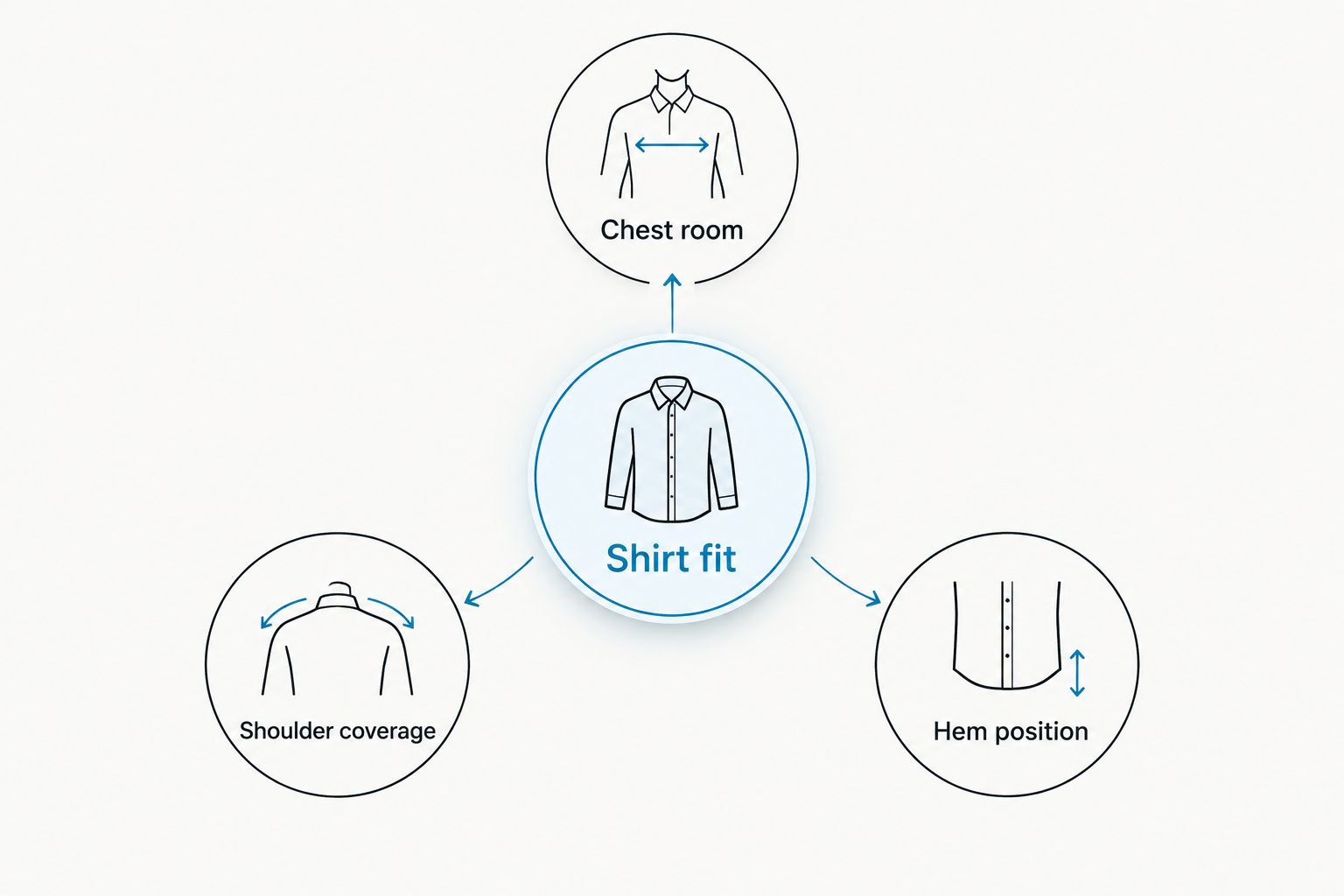
The diagram is a fit checklist, not a reason to favor one cut for everyone. Your preferred coverage belongs in the decision, including when you train in a shared space or want the same shirt for errands afterward.
- Choose sleeves or uncovered shoulders deliberately.
- Check the hem in both upright and overhead positions.
- Inspect the neckline while leaning forward.
- Avoid using a larger size to solve every fit problem.
Separate fabric facts from product language
Read the material and care information before accepting performance language. A product called a workout shirt does not, by that name alone, establish moisture management, stretch, opacity, or resistance to repeated washing. Each of those needs its own supporting detail.
Start with the information that answers your use case. For cardio, ask what the listing actually says about the fabric and construction. For lifting, check whether the stated material details address the movement and coverage issues you identified earlier.
The supplied tank excerpt gives measurements, but it does not establish a fabric composition or care routine. Treat those as separate checks. Do not turn missing details into favorable assumptions.
Make this your 2026 product-page filter: a claim needs an explanation you can use. A motivational name tells you something about the message. It does not tell you how a garment handles sweat or repeated wear.
- Find the stated material composition.
- Read the care instructions before purchase.
- Distinguish measured specifications from descriptive adjectives.
- Ask about any unresolved detail that affects your choice.
Build one outfit around the whole session
Start with clothing you already own and identify the missing piece. You do not need a whole new training wardrobe to choose a more meaningful shirt. A clear gap—such as unwanted sleeve coverage or an unsuitable hem—is a better reason to buy than a matching theme alone.
For mixed sessions, assess the shirt across the full sequence. The same principle applies to workout clothing for CrossFit: evaluate the garment during both lifting positions and repeated conditioning movements, rather than judging it on a standing pose. The broader training label does not remove the need for a personal fit check.
Try the reference shirt with the bottoms and layers you normally wear. Look for overlap at the waist, fabric bunching, and any need to keep readjusting. This is an outfit check, not proof that a different garment will behave identically.
Buy the piece that solves the identified problem. Keep the message personal, but make the clothing decision practical.
- Pair the reference shirt with your usual training bottoms.
- Repeat the movements from your main session.
- Check whether layers change the neckline or hem position.
- Choose the missing garment rather than an unnecessary bundle.
Compare shirt options before you choose
Choose by your coverage preference first, then confirm the individual listing. This comparison describes garment options, not tested performance results. A cut gives you a starting point; fabric, measurements, and construction still need checking.
| Option | Best for | Main advantage | Key limitation |
|---|---|---|---|
| Lift It All Away Tank Top — Men's Gym Muscle Weightlifting Workout Tank | Lifters seeking a named motivational tank | The listing includes chest and back-length measurements | The supplied excerpt does not establish fabric composition or a scripture-based design |
| Regular workout tee | Shoppers who want sleeve coverage | Covers the shoulders without requiring a separate layer | Sleeve openings and shoulder seams still need a movement check |
| Loose pump-cover shirt | Lifters who prefer extra room through the torso | Offers a roomier silhouette when the cut is designed that way | Extra fabric requires checking during exercise; sizing up alone does not establish the cut |
| Close-fitting workout shirt | Shoppers who prefer less loose fabric | Keeps the silhouette closer to the body | A close fit does not establish compression performance or comfortable movement |
Kline Strong’s motivational tank is a relevant option if its message and sleeveless cut match your needs. Its limitation is equally clear: measurements do not answer every fabric or design question. Choose it on verified details, not an imagined specification sheet.
Common mistakes Christian lifters make
Treating a faith-led brand as proof of every design
A brand’s mission and an individual shirt’s artwork are different things. If you want an explicit Christian reference, confirm it on the garment. If a broader message is enough, choose it honestly without adding religious details that are not there.
Choosing the slogan before checking the cut
A message you love will not fix a neckline you keep pulling into place. Decide what coverage and movement you need before letting the artwork settle the purchase. Meaning and fit should both pass.
Assuming fitted means compression
A close-fitting shirt and a compression garment are not interchangeable descriptions. Do not infer a technical function from a tight silhouette. Read the stated construction and purpose instead.
Turning mental-health motivation into a promise
A shirt can express solidarity, personal meaning, or awareness. Clothing and supplements are not mental-health treatment, and lifting does not replace professional care. Keep the message supportive without making someone’s recovery a test of effort or faith.
FAQ
What are Christian workout shirts?
Christian workout shirts are training tops chosen for a Christian message or faith-connected meaning. Check the individual design to distinguish explicit scripture or symbols from broader motivational wording.
Are Christian workout shirts better for lifting or cardio?
The individual garment determines its suitability for lifting or cardio, not the Christian message. Compare its measurements, coverage, material details, and construction with the movements in your session.
Does every Kline Strong shirt have scripture on it?
Do not assume every Kline Strong shirt includes scripture. The brand connects fitness with faith and mental-health awareness, but each design needs its own check for religious wording or symbols.
Should I choose a tank top or a tee for lifting?
Choose a tank when you prefer uncovered shoulders and a tee when you want sleeve coverage. Check overhead reach, forward leaning, and your preferred hem position before settling on the cut.
Should I size up in a Christian workout shirt?
Choose the size by comparing garment measurements with a shirt that already fits you. Sizing up changes several dimensions and does not automatically create a well-fitting oversized cut.
What should I check before buying a workout shirt in 2026?
Check the design, garment measurements, material composition, and care instructions. Confirm that any performance claim is supported by the listing rather than inferred from the product name.
Can a mental-health workout shirt replace getting support?
No, a mental-health workout shirt cannot replace professional care. Wear it as an expression of meaning or awareness, not as a treatment promise or a measure of anyone’s recovery.
One last thing
Keep the shirt’s message separate from a judgment about yourself. Wearing a faith-connected design does not require you to have every part of life sorted out. Choose words you mean and a garment you can move in; neither needs to prove your worth.
Before you buy, write down the single fit problem your next shirt should solve. That small decision makes the product page easier to judge—and keeps a powerful slogan from making the whole choice for you.